
Description vs analysis
How to move from narrating what happened to arguing why it matters — central to history marks.
Not sure where to start? Talk to our support team live.
History & Research Topics
Need a history research-paper or essay topic? This guide gives ideas across British, European, world, political, social, women’s, colonial and economic history — and, more importantly, shows how to turn a broad period into a focused, arguable question you can actually evidence.
The short version
A strong history research-paper topic is focused enough for your word count, arguable rather than purely descriptive, and supported by accessible primary and secondary sources. The best ideas start from a period or theme you find interesting, then narrow to a specific issue, evidence base and historical debate you can turn into a clear research question.
On this page
Start here
A list of titles is the easy part; the skill is choosing one you can research and argue well. Whether it is a short essay or a longer research paper, the same academic thinking applies, and our history assignment support is built around helping you plan and review your own work rather than writing it for you. A strong history topic is:
Below you will find ideas by field, then the process that turns any of them into a defensible research question.
The essential skill
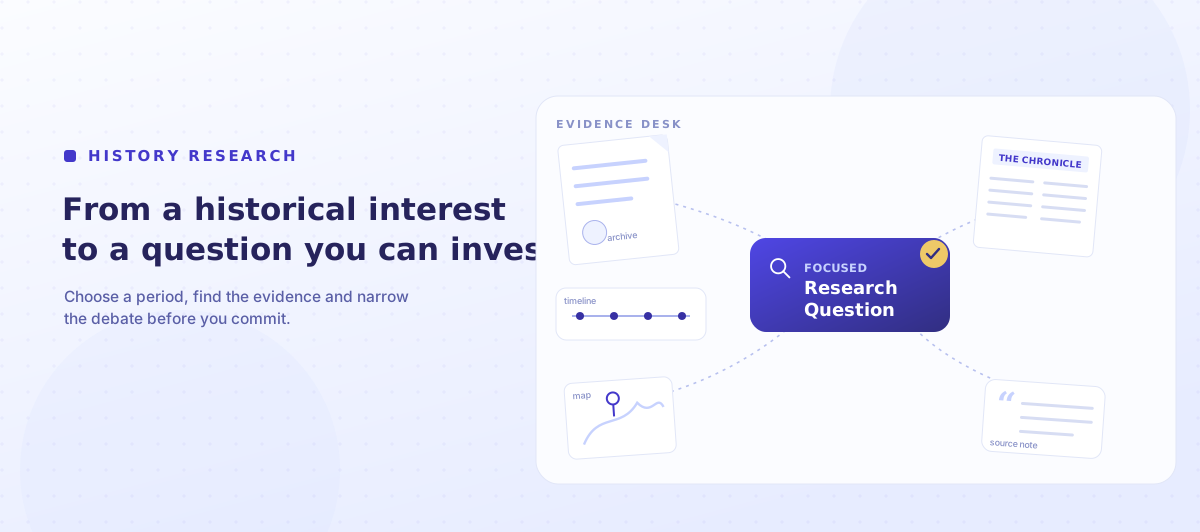
Most weak history questions are really just subjects: “the Industrial Revolution” is a century of change, not a question. Narrowing means adding a specific issue, an evidence base, a defined scope and a historical debate until you have something arguable. Work through it in stages:
From broad period to an arguable question
Before you commit to a question like this, check it against six things: primary-source access (can you reach the records?), historiographical debate (do historians disagree about it?), a defined date range and geography, word-count feasibility, and whether the question invites argument rather than description. The example above is a teaching illustration — your question and argument must be your own, built from your own reading. For the shift from narrating to arguing, our guide to description vs analysis is a useful companion.
Check the brief first
Before choosing a history topic, check what your brief actually requires
Your topic still has to answer the assignment brief. Brief Decoder breaks the task, command words and marking criteria into clear requirements so you can test your idea before you start researching.
Decode My BriefIdeas by field (1 of 2)
Use these as starting points, then narrow the one that fits your brief using the process above.
Primary sources for these are more accessible than students expect: The National Archives and the British Library hold vast digitised collections, and the Imperial War Museums are invaluable for conflict history.
Ideas by field (2 of 2)
For political and parliamentary topics, UK Parliament’s Living Heritage is a strong starting point. If you are weighing several dissertation-style ideas, our research topic-selection guide covers the same narrowing method for other subjects.
Before you commit
An exciting topic is still a bad choice if you cannot evidence it. Before you build a paper around a question, check it honestly:
A narrower question you can evidence and argue will always beat a sweeping one you can only summarise.
Test your idea
Found a topic? Check it fits the assignment before you start researching
Use Brief Decoder to identify the task, scope and marking expectations, then shape your own research question around what the assessment actually requires.
Try Brief DecoderWhy us
My Perfect Writing helps UK history students understand their brief, plan their own work, review their own drafts and understand feedback — while the research, argument and writing remain entirely their own.
Brief Decoder helps you identify the task, command words, criteria and scope before you choose or narrow a topic.
Once you have written your own essay or paper, Marker’s Eye reviews structure, argument and use of evidence against marking expectations. It does not write or rewrite it.
Feedback Decoder helps you turn tutor or marker comments into clear, specific actions on your own work.
We help you plan how to use and reference primary and secondary sources — the analysis and interpretation stay yours.
Your reading, argument, evidence and final writing remain your own; support is focused on clarity, planning and review.
Use the free Research Question & Source Feasibility Planner to test an idea before you commit.
You stay the author of your own work — our tools help you understand, plan and review it, they do not write it for you.
Questions