
Reviewing authenticity signals responsibly
How to check your own work for authenticity and integrity, the responsible way.
Not sure where to start? Talk to our support team live.
Academic Integrity
Searching for “nursing assignment help” brings up everything from genuine tutoring to essay mills that break the law. This guide shows UK nursing students how to tell legitimate, safe academic support from services that would put your degree — and your professional registration — at risk.
The short version
Legitimate nursing assignment help supports your own learning — explaining briefs, tutoring, building skills, and giving feedback on work you wrote yourself. It becomes unsafe, and in England illegal to provide, when a service writes, edits or sells assessed work for you to submit. If a provider promises grades or hands you ready-made answers, walk away.
On this page
Look past the label
Search “nursing assignment help” and you will see wildly different things behind the same phrase — some genuinely useful, some that could end your degree. It is worth being precise, because the marketing term hides a spectrum that runs from legitimate nursing assignment support and feedback to services that quietly write assessed work for you. Knowing which is which is the whole game.
Under one banner you will find very different offers:
The first four keep you as the author. The last one does not — and that single distinction is what the rest of this guide is built around.
The safe zone
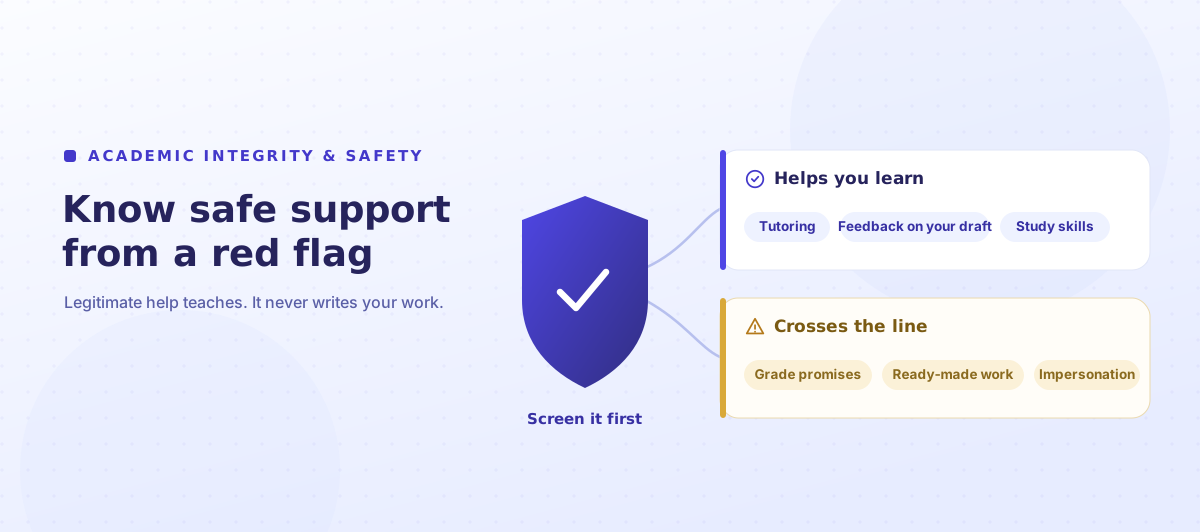
The simplest test is this: does the support help you do the thinking, or does it do the thinking for you? Support is safe when you remain the author — when it helps you learn, understand, plan, review and build skills you keep. It crosses the line when it produces the work you hand in.
Helps you stay the author
Does the work for you
Proofreading has a limit Light proofreading — fixing typos, spelling and punctuation — is usually fine. But once “proofreading” starts rewriting your sentences, restructuring paragraphs or changing your meaning, it has become editing your work for you. Keep any correction surface-level, keep your own words and ideas, and check your university’s proofreading policy, as some set explicit limits.
Used responsibly, study tools and AI can sit firmly in the safe column — supporting your own learning rather than replacing it; our AI usage policy explains where that line sits. A legitimate service should be just as clear about where its support deliberately stops.
Warning signs
Most unsafe services do not announce themselves — but they share tells. Use the two lists below to screen any provider before you upload a brief, share your work, or pay.
Green flags — safer to consider
Red flags — walk away
The tell that ties these together is evasiveness. A safe provider can answer “what exactly will you do, and will I still be the author?” in one clear sentence. If the answer is vague, buried in marketing, or met with pressure to pay before you have understood it, treat that hesitation as your answer. Note, too, that submitting work generated for you by AI is treated as academic misconduct at UK universities in the same way as work bought from a person.
A safe alternative
Have a draft? Review it yourself instead
If what you really want is to know where your assignment is weak, that is a safe thing to do. Marker’s Eye reviews a draft you wrote against UK marking expectations and shows what to improve — you keep authorship, and it never writes the work for you.
Try Marker’s EyeThe current UK position
Yes — in England. The Skills and Post-16 Education Act 2022 made it a criminal offence to provide or arrange a cheating service for financial gain (section 27), and to advertise one (section 28), for students at post-16 and higher education institutions in England. The law targets the providers and advertisers — the essay mills — rather than criminalising the student.
That last point matters, and it is where a lot of marketing is misleading. The fact that a student is not prosecuted under this Act does not make using such a service safe. If you submit work you did not write, you can still face your university's academic-misconduct process, which can mean a capped mark, a module fail, or removal from your course. For an educational overview of how universities treat this, the QAA's contract cheating guidance is a recognised reference.
A note on scope: this Act applies to England; Scotland, Wales and Northern Ireland are not covered by it, though academic-misconduct rules apply everywhere. This is a general educational overview, not personal legal advice — check your own institution's regulations, and see our academic integrity page for how we approach this.
Why nursing is different
For nursing students the stakes are higher than a grade, because your academic record connects to your professional standing. Two issues deserve particular care:
If you must share any work that references practice — even for legitimate feedback — strip anything that could identify a person or place first: real names and initials, dates of birth, exact dates, ward or unit names, the employer, and small details that combine to identify someone. Share the minimum necessary, and only with a provider whose data handling you trust.
Reflective and evidence-based nursing work is also deeply personal to your own learning — it is precisely the kind of assignment that loses its value, and its safety, when someone else writes it.
Protect your work
Before you upload a brief or a draft anywhere, ask a question most students forget: where does my work go, and who can see it? Your assignment and your account details are personal data, and an untrustworthy service is a risk to both your integrity and your privacy.
If a provider cannot tell you plainly what happens to your uploads, that silence is information. Treat your unpublished work like any other sensitive document, and only share it where the answer is clear.
Screen it first
If you cannot get a straight answer to these, treat that as your answer — and walk away.
Safe next steps
Being stuck is normal, and there is always a safe way forward that keeps the work yours. Match the support to the actual problem:
Start with your module handbook and your supervisor. To turn dense wording into concrete requirements yourself, our Brief Decoder can help you unpack what the task is really asking — you still plan and write it.
Review your own draft
Check your draft — don’t outsource it
This is a genuine, safe review moment. Marker’s Eye reviews a draft you wrote against UK marking expectations and shows where to strengthen it — you make every change. It never writes or rewrites the assignment for you, and it cannot promise a grade.
Try Marker’s EyeBefore rewriting blindly, decode the comments. Our Feedback Decoder helps you translate tutor feedback into clear actions on your own work.
The safe answer is never to outsource the assessment. Talk to your personal tutor or university support team early — extensions and mitigating-circumstances processes exist for exactly this. Build a realistic plan, and use legitimate tools to work more efficiently rather than paying someone to replace your authorship.
Questions