
Choosing a criminology dissertation topic
The same relevance-and-feasibility logic applied to another field — how to turn interest into a researchable focus.
Not sure where to start? Talk to our support team live.
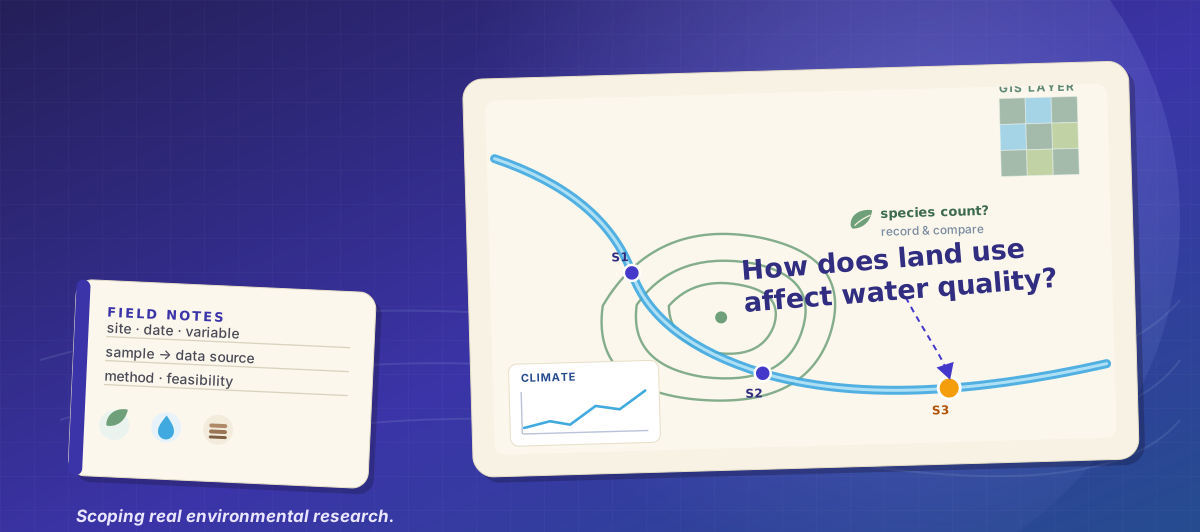

Environmental Science & Research
Environmental science dissertation ideas across climate, biodiversity, pollution, energy, water, cities and policy — grouped with a research angle, a suitable data source, a likely method and a feasibility note, plus how to narrow a broad theme into one researchable question.
The short version
The best environmental science dissertation ideas come from narrowing a broad issue — climate, biodiversity, pollution, energy, water or policy — into one focused, researchable question you can actually answer with available UK data and a suitable method. Choose a topic that is relevant, feasible and genuinely interesting, then test it against research ethics and data availability before you commit.
On this page
Start here
A strong topic is not the biggest or most urgent issue — it is the one you can research well in the time and with the data you have. Before you browse ideas, weigh every candidate against four tests:
It also helps to see how students in other fields scope a project: our guides to choosing a criminology dissertation topic and accounting dissertation topics use the same relevance-feasibility logic. For the definitive scope, word count and marking criteria, always check your own module handbook — and if you want subject-specific guidance, our environmental science assignment help explains what UK markers look for.
The core skill
“Climate change” is a subject, not a dissertation. The work is turning a broad issue into a single question with a clear scope. A reliable way to narrow down is to pin four things:
A good research question is specific, answerable and honest about scope. It usually begins with how, to what extent, what is the relationship between, or how effective is. If your question could be a whole research centre’s five-year programme, it is still too broad — keep cutting until one student could answer it in one project.
A practical example
Here is one practical example of turning a broad theme into a focused, researchable dissertation question — the pattern matters more than this specific case:
Notice the pattern: theme → place → system → variable → comparison → question. The same funnel turns any of the areas below into a project you can actually finish. Keep your own research original and your writing your own work.
Reality check
Most dissertations fail at the feasibility stage, not the idea stage. Before you commit, confirm you can actually get the data. The UK has excellent official sources: the Environment Agency / DEFRA Data Services Platform for spatial and environmental monitoring data, the Met Office for climate data, and the UK Centre for Ecology & Hydrology for ecological and hydrological datasets. Policy context sits with DEFRA.
Feasibility means asking: is the data current and accessible, do I have the equipment or software, and can I finish within the deadline? Research ethics matters even in environmental science — fieldwork on private land needs permission, sampling can need licences, and any work involving people (surveys, interviews) needs ethical approval from your department before you begin. Never plan a study your institution could not approve.
Methodology
You do not always need to generate new data. Decide early between:
Then match your research methodology to the question: quantitative methods for measuring, modelling and testing relationships; qualitative methods for perceptions, behaviour and policy interpretation; and mixed methods when a question has both a measurable and a human dimension. Our research paper support explains how to justify a methodology, and if you are moving toward a larger project, our thesis support covers structuring longer research. The method should serve the question — never pick a method first and force a question onto it.
Ideas by area
| Research area | Example topic angle | Data source & likely method | Feasibility note |
|---|---|---|---|
| Climate change & adaptation | How effective are a city’s local climate-adaptation measures? | Met Office climate data + policy documents; quantitative or mixed | Strong if you scope to one city and a defined period |
| Biodiversity & conservation | How does habitat fragmentation affect a species in one reserve? | UKCEH / biological records + field survey; quantitative | Field access and species ID skills are the main limits |
| Pollution & waste | Microplastics or nutrients along one river catchment | EA/DEFRA monitoring data or sampling; quantitative | Secondary data is far more feasible than new sampling |
| Renewable energy | Public acceptance of local wind or solar development | Surveys/interviews + planning records; qualitative or mixed | Feasible without a lab; needs ethical approval for people |
| Water & marine environments | Water quality change linked to land use in one estuary | EA water-quality data + GIS land-use layers; quantitative | Good open-data project; check dataset coverage first |
| Sustainable cities | Urban green space and heat, or active-travel uptake | Local authority open data + remote sensing; mixed | Scope to a few wards to keep it manageable |
| Environmental policy | How well is one UK environmental policy being implemented? | DEFRA/gov documents + stakeholder interviews; qualitative | Document access is easy; interviews need ethics sign-off |
| Environmental justice | Who is exposed to poorer air quality within one city? | Air-quality + census data in GIS; quantitative | Powerful with open data; define the area tightly |
| Agriculture, soil & land use | Effect of a land-management practice on soil health | Field/lab measurement or existing trials; quantitative | Lab access and a growing season are the constraints |
| GIS, remote sensing & data | Mapping land-cover or flood-risk change over time | Copernicus/Sentinel or OS/EA layers in GIS; quantitative | Excellent no-fieldwork option if you know a GIS tool |
Examples to spark a direction, not prescriptions — confirm scope, data access and requirements with your own department before committing.
Enabling skills
GIS (geographic information systems) and remote sensing are both dissertation topics in their own right and enabling skills for almost every area above. Freely available environmental data — satellite imagery, monitoring networks and spatial layers — means a rigorous, data-rich dissertation no longer requires expensive fieldwork.
If you can handle spatial data, secondary-data projects on land cover, flood risk, air quality, water quality or urban heat become very feasible. Just be realistic: learning a GIS package takes time, so factor that into your plan, and make sure any dataset you rely on genuinely covers your chosen place and period before you build a whole project on it.
Avoid these
The most common mistakes are avoidable once you know them:
Turn an idea into a plan
Brief Decoder reads your dissertation or proposal brief — the task, requirements and marking guidance — so your chosen topic actually answers what your department asks. You do the research and writing; every word stays your own.
Before you commit
Use this on your own shortlist — always defer to your department’s requirements for the definitive scope and rules.
Why us
My Perfect Writing helps environmental science students scope a topic, understand their brief and review their own work — while they stay responsible for their own research, analysis and writing. We do not complete dissertations or fabricate data.
Brief Decoder helps you read a dissertation or proposal brief — the task, requirements and marking guidance — so your topic answers what your department asks.
Our environmental science assignment help explains what UK markers expect from environmental research and writing.
Guidance reflects UK dissertations, official environmental data sources, and department ethics processes.
The research question, data, analysis and writing remain yours. We do not complete dissertations or invent findings.
Use the free topic and feasibility builder before deciding whether you need any further guidance.
You stay responsible for your own dissertation — our tools help you scope and check it, they do not do it for you.
Questions
Before you write your proposal
Use this guide to narrow a broad theme into a researchable question, then let Brief Decoder check that your topic answers exactly what your dissertation brief asks.
Guidance should support your research, not replace your own work.