

Criminology & Law
Criminology Dissertation Topics: How to Choose Your Research Focus
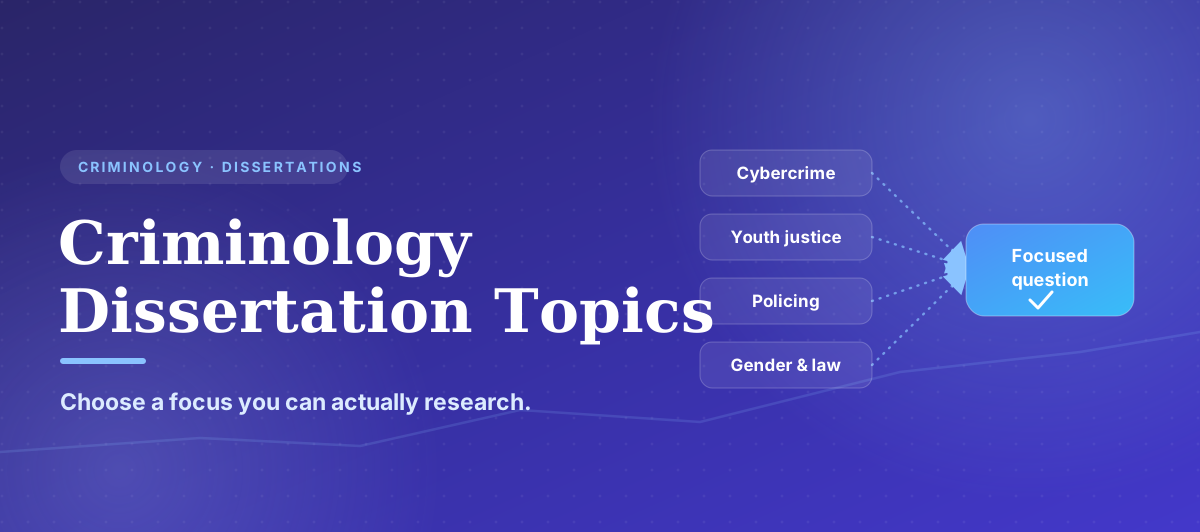
Long topic lists are easy to find; a focus you can actually research is harder. This guide gives you current UK criminology topic clusters for 2026 and a simple framework to turn a broad area into a feasible, ethical research question.
The short version
Quick answer
A good criminology dissertation topic is a focused, researchable question — not a broad theme. Start from a current area such as cybercrime or youth justice, find a genuine research gap, then check feasibility: can you access the data, is it ethical, and is the scope realistic for one dissertation? That gives you a question you can actually answer.
On this page
In this guide
The basics
What makes a good criminology dissertation topic?
A strong topic is a specific, answerable research question — not a broad subject area. “Youth crime” is a field; “How do school-based mentoring schemes affect reoffending among 14–17-year-olds in England?” is a dissertation.
The best topics are current, connect to real UK evidence — for example the ONS Crime Survey for England and Wales — and target a research gap: something not yet answered, or answered only in a different context.
Focus, not topic If you can state your work as one clear question with a defined population, place and outcome, you have a focus. If it still sounds like a chapter title, keep narrowing.
The framework
How to choose your research focus, step by step
Work down from a broad field to a single question, checking feasibility before you commit:
- Pick a broad field that fits your interests and the modules you did well in.
- Narrow to a current theme — a debate, policy or trend that is live in the UK right now.
- Find a research gap by reading recent studies and noticing what they did not answer.
- Run a feasibility check — data, ethics and scope (see below).
- Write it as a focused question with a clear population, place and outcome.
Decode your brief before you write
Chosen a research focus?
Brief Decoder turns your dissertation brief into a plain-English plan — the real question, where the marks are, the hidden requirements, and a step-by-step structure — so you can start with confidence. You stay the author of your work.
See it applied
Worked example: from a broad area to a focused question
Here is the funnel applied to one of the most current UK areas — cybercrime, where fraud and computer misuse make up a large share of the crime measured by the ONS Crime Survey for England and Wales.
Broad field Cybercrime.
Current theme Online fraud targeting older adults.
Research gap There is plenty of data on how common fraud is, but far less on how banks’ warning messages change what victims do next.
Feasibility check Secondary data and a small survey are realistic; ethical risk is low if you avoid identifying vulnerable victims; the scope is one clear relationship, not five.
Focused question How do UK banks’ anti-fraud warning messages influence reporting behaviour among people aged over 65?
Notice how each step narrows the field until the question is specific enough to answer in one dissertation.
Choosing a cluster
Choosing between criminology topic clusters
| Topic cluster | Why it is current in the UK | Possible data sources | Ethics / access | Example focused question |
|---|---|---|---|---|
| Cybercrime & fraud | Large and rising share of recorded crime | ONS CSEW, Action Fraud, published reports | Low with secondary data | How do bank fraud warnings affect victim reporting? |
| Youth justice & county lines | Ongoing policy and exploitation concern | Youth Justice Board, Home Office, MoJ | High — under-18s need approval | How do diversion schemes affect first-time entrants? |
| Policing & penology | Trust, reform and reoffending debates | MoJ statistics, HMIP inspection reports | Medium — institutional access | What shapes public confidence in local policing? |
| Gender, domestic abuse & law | Recent legislative change | ONS domestic abuse data, court statistics | High — vulnerable participants | How is coercive control charged and sentenced? |
| Victimology | Focus on victim experience and support | CSEW victim modules, charity reports | Medium — sensitive topics | What affects satisfaction with victim support services? |
| Rehabilitation & desistance | Reducing reoffending is a policy priority | MoJ reoffending data, evaluations | Medium — offender access | Which factors support desistance after release? |
| Organised & white-collar crime | Fraud, corruption and regulation focus | Court records, regulator reports | Low–medium with documents | How effective are UK anti-money-laundering rules? |
Data sources such as the Ministry of Justice criminal justice statistics and the Youth Justice Board are free and widely accepted in UK dissertations.
Before you commit
Feasibility: data, scope, methods and ethics
Most topics fail not because they are uninteresting, but because they are not feasible. Check four things before you commit:
- Data availability. Can you use secondary data (ONS, MoJ, Youth Justice Board) or must you collect your own? Secondary data is usually faster and more reliable at this level.
- Scope. One clear question, not five. A narrow question you answer well beats a broad one you only describe.
- Methods. Match the method to the question — quantitative for “how much/how many”, qualitative for “how/why”.
- Ethics. Primary research with people usually needs ethical approval, and studies involving offenders, victims or under-18s can be restricted. Read your university’s process and the British Society of Criminology’s statement of ethics early.
If you are unsure what a criminology dissertation should demonstrate, our criminology and criminal justice guidance explains what UK markers expect on scope, evidence and structure.
Avoid these
Common mistakes when choosing a topic
- Too broad. “Cybercrime in the UK” is a module, not a dissertation.
- No data access. A great idea you cannot get evidence for is not researchable.
- Ethical barriers. Assuming you can interview prisoners or gang members — access and approval are often not possible at undergraduate level.
- No research gap. Re-answering a settled question adds little; find where the evidence stops.
- Chasing a trend you cannot feasibly study within your time and resources.
Whatever you choose, the research and analysis must be your own, in line with academic integrity.
Quick check · 30 seconds
Can you spot a dissertation topic that will actually work?
Test whether you can recognise the difference between an interesting subject and a feasible dissertation question.
You can spot the problems in someone else’s topic. Now check your own.
Use the same checks on your own idea before you commit to it.
Use the Free Criminology Dissertation Topic PlannerBefore you write
Is my topic ready? A quick checklist
- Have you identified a genuine research gap?
- Can you realistically access the data you need?
- Is ethical approval feasible for your method?
- Is the scope a single, clear question?
- Have you chosen a method that fits the question?
- Does it fit a supervisor’s area of expertise?
If you can tick all six, you have a focus you can defend.
Free resource
Get the free criminology dissertation guide
Want the topic clusters, the feasibility checklist and the funnel in one place? Enter your email and we’ll send the free criminology dissertation guide.
Why us
Why students choose My Perfect Writing
My Perfect Writing helps UK students choose a focused, feasible research topic and understand their dissertation brief — without taking authorship of the work away from them.
Your dissertation stays yours
We help you scope a topic and understand your brief. We do not choose your topic for you or write submission-ready work.
Built around UK academic expectations
Guidance reflects what UK markers and supervisors look for: a clear research gap, feasible methods, and ethical, well-scoped questions.
Clear, practical next steps
Instead of a giant topic list, you get a framework for narrowing your focus and a decoded brief to plan your structure.
Ethical academic support
We support your own research and decisions, in line with academic integrity — never outsourcing your dissertation.
Start with a free preview
Explore Brief Decoder before deciding whether you need any further guidance.
You stay the author of your dissertation — Brief Decoder helps you plan it, it does not write it for you.
Questions
Frequently asked questions
What makes a good criminology dissertation topic?
How do I choose a criminology dissertation topic?
What are current criminology dissertation topics in the UK for 2026?
Do I need ethical approval for a criminology dissertation?
Can I use secondary data for my criminology dissertation?
Before you write
Choose your focus. Then decode the brief.
Use this guide to choose a feasible, ethical research focus, then let Brief Decoder turn your dissertation brief into a clear, structured plan before you start writing.
Guidance should support learning, not replace authorship.