
Decode the full assignment brief
Establish the task, scope and evidence requirements.
Not sure where to start? Talk to our support team live.

Study Skills
Move from the instruction to a defensible argument: decide what you will judge, how you will judge it and what the evidence permits you to conclude.
The short version
To critically evaluate means to judge the value, effectiveness or persuasiveness of something using explicit criteria and relevant evidence. Examine strengths, weaknesses, assumptions and competing interpretations, then reach a qualified judgement. In an essay plan, connect the question to evaluation criteria, compare evidence and counter-evidence, and explain the limits of your conclusion.
On this page
Practical guidance
“Critically evaluate” is an instruction to make a reasoned judgement, not to collect criticisms. You may find an approach useful, partly useful or unsuitable under particular conditions. What matters is explaining the basis of that judgement and testing it against evidence that could challenge your position.
Glasgow Caledonian University’s question guidance demonstrates how a questioning approach turns the instruction into issues for reading and writing. Before choosing an argument, establish the object of evaluation and the boundaries of the task. Are you assessing a theory, policy, interpretation, method or claim? For which setting or group?
Our command-words guide explains the broader vocabulary. This guide follows the narrower task from a single question to an essay plan. The difference is the chain of decisions, not an extra list of synonyms.
| Move | Question answered | Example planning note |
|---|---|---|
| Describe | What does the approach involve? | Explain the relevant features briefly. |
| Analyse | How might it work, and why? | Identify mechanisms and contextual conditions. |
| Evaluate | How well does it meet a relevant criterion? | Compare the evidence, limitations and alternatives. |
| Judge | What conclusion is justified? | State the overall answer and the conditions that limit it. |
These moves often work together. Description provides context; it should not replace the judgement requested.
Practical guidance
Fictional planning question: “Critically evaluate whether recorded lectures improve learning for first-year university students.” This is an illustration, not a live assignment or a claim about actual research findings.
The command asks for evaluation. The object is recorded lectures as a way to improve learning. The population is first-year students. “Learning” requires clarification: it might concern understanding, retention or application, depending on the module. Convenience or student preference can matter, but neither automatically demonstrates improved learning.
Write a boundary note before reading: “I will assess learning-related outcomes in the specified population and explain where evidence from other settings is less applicable.” Check your brief for a required discipline, date range or evidence type. If a term remains ambiguous, record the issue and ask the tutor rather than silently substituting a question you prefer.
A provisional answer might be that recordings are useful under some conditions but cannot be evaluated from availability alone. Treat this as a hypothesis to test, not a position that every source must confirm.
| Illustrative criterion | Evidence to look for | What would not settle it |
|---|---|---|
| Understanding or retention | A relevant measure, comparison and account of the learning context. | Students liking the recordings. |
| Application of knowledge | Evidence of using learning in a task beyond replaying content. | A count of video views. |
| Accessibility and participation | Information about barriers and how different students use the provision. | Assuming identical access or use. |
| Conditions of effectiveness | Teaching design, use patterns and alternative explanations. | Treating all recorded-lecture arrangements as the same. |
These are illustrative criteria. Derive the final set from your question, module concepts and actual rubric.
Practical guidance
For each criterion, record the source, the relevant finding or argument, the method or basis of the claim, and the limits on its use. A useful evidence note says what a source allows you to argue. It does not simply copy an abstract or label the whole article “good”.
In this fictional question, imagine that one source reports a positive association between viewing and an assessment outcome. You would still need to examine whether students who viewed more differed in prior attainment or study habits. Another source might describe students using recordings to revisit difficult concepts. That may illuminate a mechanism without proving a causal improvement.
These are examples of questions to ask, not invented studies or findings to cite. In the actual essay, insert verified sources and accurately report their methods. Do not turn an association into a causal claim or generalise from a setting that differs materially from the task.
Read why adding more sources is not always the answer if your plan is becoming a bibliography. The aim is enough appropriate evidence to test the argument, not a citation quota.
Apply the guide
Use your own task and evidence. Check tool feedback against your module guidance and choose your revisions.
Practical guidance
A counterargument should challenge an important part of your reasoning. “Some people disagree” is too vague. Ask whether an alternative explanation accounts for the observation, whether the criterion is appropriate, or whether another approach achieves the same outcome more effectively.
For the fictional example, a credible challenge could be that recordings help motivated students revise but do not independently improve learning. Your response should explain what evidence would distinguish these possibilities. If the available sources cannot resolve the issue, make that uncertainty part of the judgement.
Balance does not require equal words for every view. Give weight according to relevance and evidential strength. A weak objection should not displace a well-supported explanation merely to make the essay look symmetrical. Equally, acknowledge strong evidence that limits your preferred answer rather than hiding it in a final sentence.
Practical guidance
Claim: State a provisional answer about one criterion, such as understanding. Evidence: Identify the verified source and the particular result that supports it. Interpretation: Explain why that result matters for the question. Challenge: Test a relevant alternative explanation or a limit in the research. Judgement: State what remains convincing after that test.
An illustrative planning sentence is: “Evidence of repeated access may support an opportunity for revision, but it does not by itself establish improved understanding; the evaluation needs an appropriate outcome measure and a comparison that addresses differences between users.” This is a reasoning pattern, not an empirical finding.
The paragraph’s job is to advance the answer, not simply introduce a source. Avoid a sequence where every paragraph begins “Author A says” and ends with an unrelated limitation. Group sources around the criterion or contested claim, then explain their agreement, disagreement and relative relevance.
The Manchester Academic Phrasebank offers language for questioning interpretations and identifying limitations. Use phrasing to clarify reasoning you have actually done; sentence starters cannot supply the missing analysis.
Practical guidance
Start the introduction with the problem, define necessary terms and identify the criteria used to judge it. State a provisional overall position that the body will justify. Keep background selective: explain only what the reader needs to follow the evaluation.
Organise the body by criteria, themes or competing explanations when that arrangement answers the question. For the example, sections might examine learning outcomes, accessibility and the conditions under which recordings are used. Within each, compare evidence and reach a limited judgement. A different assignment may require a different structure.
In the conclusion, combine the section judgements into a direct answer. Say whether the claim holds, to what degree and under what conditions. Do not introduce new evidence or convert a cautious body into an absolute final statement. If the evidence is inconclusive, explain exactly which part remains unresolved.
Practical guidance
A qualified judgement identifies a boundary. “Both sides have advantages and disadvantages” usually leaves the evaluation unfinished. A stronger planning statement identifies which criterion carries most weight, what the evidence supports and where the answer changes.
For the fictional question: “The case for benefit would be strongest where recordings are integrated into active study and improvement is demonstrated through relevant learning measures; evidence of access or preference alone would support a narrower claim.” The conditional wording is deliberate because no actual studies have been evaluated in this example.
Do not use “may” to avoid deciding anything. Explain the reason for uncertainty: an untested explanation, an indirect measure, limited applicability or disagreement between credible sources. Then state the strongest conclusion still justified by what you have.
Practical guidance
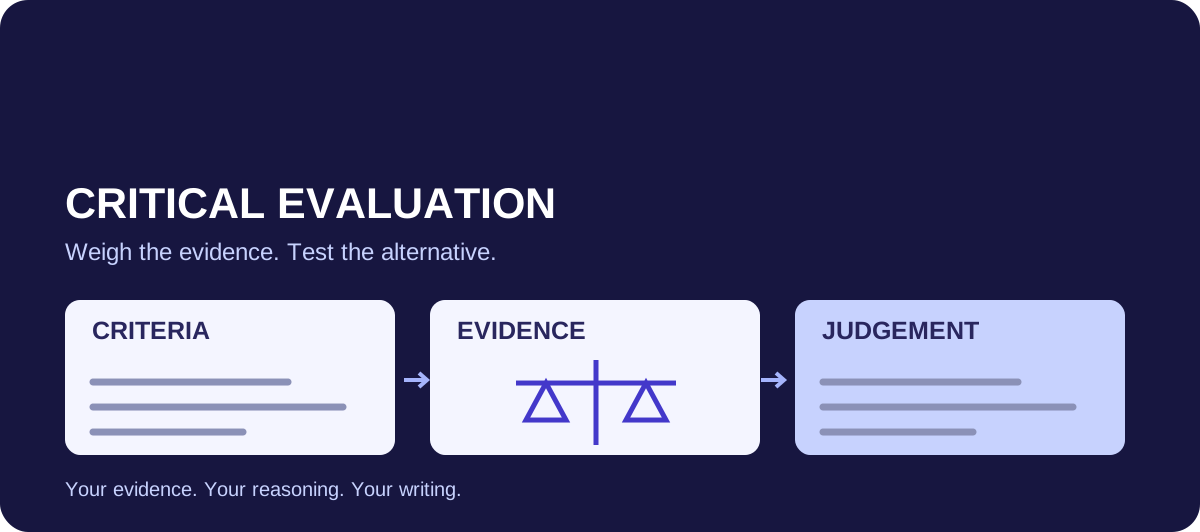
The free Critical Evaluation Argument Planner follows the same sequence: question, criteria, evidence and counter-evidence, then judgement. Fill the grid before polishing an introduction. Empty evidence cells show where reading is needed; an empty judgement cell shows where evaluation has not yet happened.
Brief Decoder helps interpret the task and supplied criteria. Include the task statement, not a rubric alone. Once your own draft exists, Marker’s Eye provides rubric-led review prompts. Neither replaces checking sources or making the final judgement yourself.
MPW editing and formatting support can help review clarity and organisation in your own work. For the wider task, return to the assignment-brief guide. Your next action is to choose one criterion and write the evidence needed to defend a judgement about it.
Questions
Your next step
Use the free planner and relevant support to improve your process. You remain responsible for the interpretation and final writing.
Follow your brief and academic-integrity requirements.