
Choose a dissertation topic
Start with a manageable criminology research focus.
Not sure where to start? Talk to our support team live.
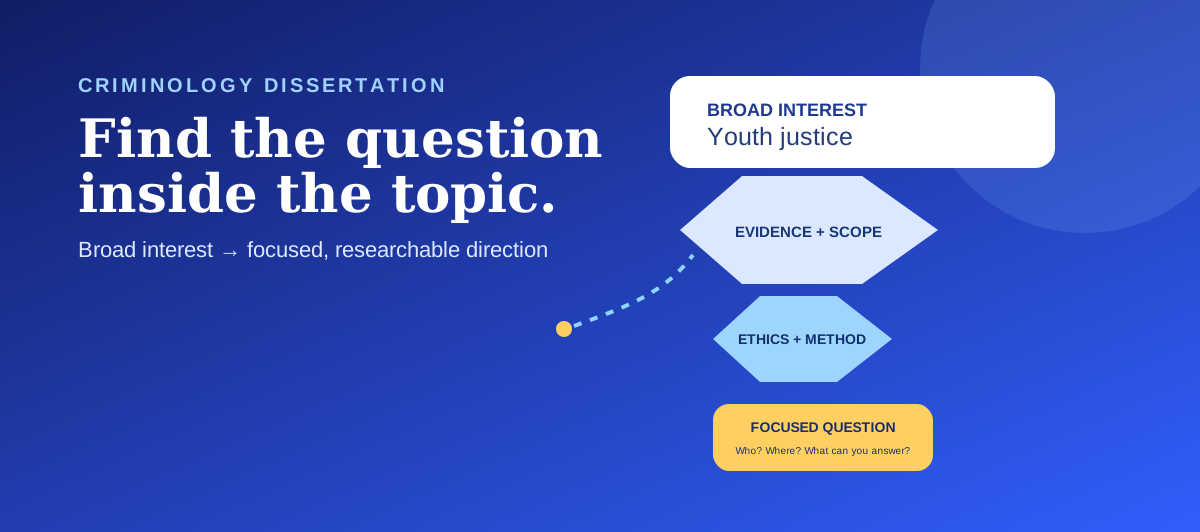

Dissertation Planning
A strong criminology dissertation question gives your literature review, method and analysis a clear job to do. Here is how to make yours focused enough to answer and broad enough to matter.
The short version
A good criminology dissertation research question is specific, answerable with available evidence, ethically feasible and clearly connected to your course. Start with a broad issue, identify a population, setting and relationship you can realistically investigate, then test whether your proposed method can answer it.
On this page
Start with the question
Your research question is the decision that keeps a dissertation from becoming a collection of interesting facts. It tells you what literature to read, what evidence you need and what your analysis must answer. In criminology, a workable question also needs to respect access, ethics and the time available. If you need help understanding the standards of a university research project, My Perfect Writing’s criminal justice assignment help offers ethical academic guidance while you keep ownership of the work.
Choose a research area first, then narrow it. Our guides to criminology dissertation topics and criminology methodology help with the adjacent decisions.
Narrow with purpose
| Too broad | Useful narrowing choice | More researchable direction |
|---|---|---|
| Youth crime | A place, age range and intervention | How do diversion schemes affect reoffending narratives among 16–18-year-olds in one local area? |
| Police legitimacy | A group and experience | How do university students describe trust in police after reporting online fraud? |
| Prison rehabilitation | A programme and outcome | What barriers do former prisoners report when accessing employment support after release? |
These are planning models, not ready-made dissertation questions. Adapt them to your brief, evidence access and ethics requirements.
Use four tests
For ethics, start with your department’s process. The British Society of Criminology Code of Ethics is also a useful professional reference for thinking about consent, harm and confidentiality.
Plan before you search
Brief Decoder helps you unpack the command words, limits and assessment criteria in your own dissertation brief. It helps you plan your response; you remain the researcher and author.
Choose the form
Use how or why when you need experiences, processes or meanings; use what when mapping perceptions or patterns; use to what extent only when you can define evidence and comparison carefully. Avoid questions that assume the answer, such as “Why do social media cause crime?” A stronger version asks what relationship, among whom, and in what context you can actually examine.
Keep your question consistent with your method. A survey, interview, content analysis and literature-based dissertation each support different claims. For the full project shape, see how to structure a criminology dissertation.
Final check
Discuss the final version with your supervisor; they know your module and research constraints.
Why us
My Perfect Writing helps you move from uncertainty to a clearer research plan: understand the brief, test the scope and review your own choices. We never choose your dissertation question, collect data, fabricate research or write assessed work for you.
Brief Decoder helps you identify the required deliverable, scope and command words so you can make informed decisions before researching.
Topic-planning guidance helps you test population, setting, timeframe and available evidence instead of settling for an idea that is too broad.
Prompts encourage you to consider consent, confidentiality, harm and access before you promise a method you cannot deliver.
A clear question-and-rationale plan gives you a more productive starting point for your own supervisor meeting.
You select the question, evaluate the literature, make the ethical decisions and write the dissertation in your own words.
Use support to make better research choices; your dissertation remains your work and your responsibility.
Questions
Before you commit
Use your brief, module guidance and supervisor feedback to test the scope. Brief Decoder can help you read the task requirements, but it does not choose a topic or write your dissertation.
Your research decisions, evidence and writing remain your own.