

What is the Purpose of a Conclusion?
According to academic experts, the conclusion serves three primary functions:
-
To Synthesize: Not just repeat, but weave together your findings to answer the main research question.
-
To Elevate: To move from "what I found" to "what this means for the field."
-
To Close: To provide a sense of finality and completeness.
Think of your thesis as a legal trial. The Introduction is your opening statement. The findings are your evidence. The Conclusion is your closing argument to the jury (the examiners). It is your last chance to convince them of your case.
The 5 Essential Elements of a Thesis Conclusion
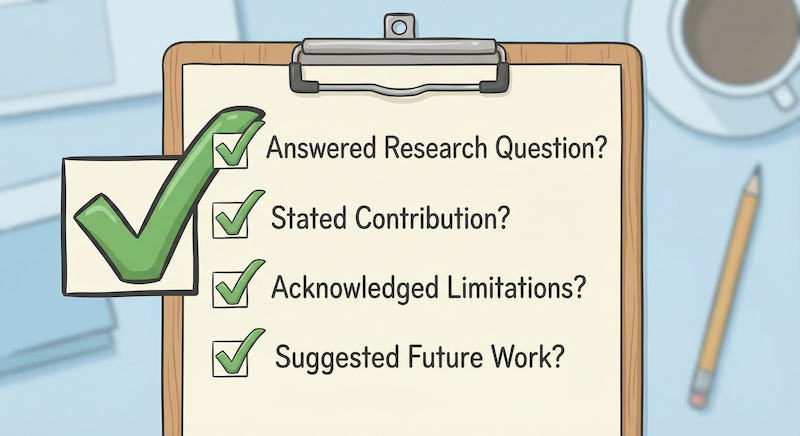
A conclusion is not a stream of consciousness. It requires structure. Ensure your final chapter hits these five key beats. When you write the conclusion chapter, it should effectively summarize the entire thesis, reinforcing your research aim and key findings. It's also essential to acknowledge the limitations of your study, addressing any constraints or challenges encountered during the research process. By doing this, you not only provide a clear summary but also set the stage for future research and show the value of your work within the broader academic field.
1. Restate the Research Question (The Reminder)
Remind the reader why we are here.
-
Don't Say: "In this thesis, I looked at X."
-
Do Say: "This research set out to investigate the correlation between X and Y, aiming to resolve the long-standing debate regarding Z."
2. Synthesize the Findings (The "Golden Thread")
This is the most critical part. Do not go chapter by chapter, summarizing what you did. Instead, identify the "Golden Thread" that runs through them. How does the finding in Chapter 4 support the theory in Chapter 2?
-
Example: "While the quantitative data in Chapter 4 suggested a decline in productivity, the qualitative interviews in Chapter 5 revealed that this was a deliberate strategic shift, rather than a failure."
3. Contribution to Knowledge (The PhD Requirement)
To be awarded a PhD, you must make an "original contribution to knowledge." State this explicitly. Be bold.
-
Phrasing: "This study contributes to the field by offering the first empirical evidence of..." or "This research challenges the dominant paradigm by demonstrating..."
4. Limitations (The Defense)
Admitting weakness is a sign of strength. It shows you are an objective researcher.
-
Example: "While the sample size was sufficient for this exploratory study, the geographic limitation to London means the findings may not be generalizable to rural populations."
This pre-empts the examiner's criticism in the Viva.
5. Recommendations for Future Research (The Legacy)
You haven't solved everything. Suggest where the next researcher should go.
-
Example: "Future research should build on this framework by applying a longitudinal methodology to assess the long-term impacts."
Common Pitfalls to Avoid
Even brilliant students trip up at the final hurdle. Here is what to watch out for.
1. Introducing New Data
The conclusion is for wrapping up, not opening up. Never introduce a new graph, a new case study, or a new theorist in the final chapter. If it were important, it should have been in the Discussion.
2. Being Too Apologetic
While you must admit limitations in your PhD thesis, don’t destroy your own work. Acknowledging limitations is important for providing context, but it’s equally vital to highlight the strengths of your research. Be clear about your research aim and how your findings contribute to the field. Your hypothesis should be the driving force behind your work, guiding your analysis and shaping your conclusions.
-
Bad: "This study was flawed because I didn't have enough time."
-
Good: "While time constraints limited the scope, the focused approach allowed for a deeper analysis of the core variables."
3. The "Grandstand" Ending
Avoid overly emotional or dramatic language. "This thesis will change the world forever" is arrogant. Stick to academic modesty: "This thesis offers a significant step forward in understanding..."
University of Manchester – Writing Conclusions – See official guidance on academic tone.
How My Perfect Writing Polishes Your Final Chapter
Writing the conclusion is often the hardest part because you are too close to the work. You can't see the wood for the trees. This is where My Perfect Writing comes in.
Professional Doctoral Thesis Writing Services
We offer a fresh pair of eyes. Our team of PhD-qualified writers can review your 80,000 words and help you identify the "Golden Thread" that ties it all together. Whether you are stuck on the Introduction or the Conclusion, our professional thesis writing services ensure your narrative arc is complete.
PhD Thesis Writing Services UK Standards
A UK PhD is different from a US one. We understand the specific requirement for "critical synthesis" over "descriptive summary." When you ask us to write my PhD thesis for me (or just the conclusion), we ensure the tone meets the rigorous standards of British universities. Our team focuses not only on crafting a strong discussion that critically evaluates your findings but also on writing a conclusion that ties everything together. In PhD writing, every section is meticulously structured to ensure clarity, coherence, and a well-rounded reflection of your research, contributing to your overall thesis success.
Pay 25% Upfront: Risk-Free Support
We know that by the end of a PhD, funding is tight. We have revolutionized the industry.
Get expert thesis help with transparent pricing — pay
just 25% upfront.
-
Step 1: Deposit 25% to secure a subject-matter expert.
-
Step 2: We draft or edit your conclusion.
-
Step 3: You review the synthesis and the tone.
-
Step 4: Pay the remaining balance only when you are satisfied.
Bachelor Thesis Writing Service
This advice isn't just for PhDs. If you are an undergraduate asking to "write my thesis," the same rules apply. A strong conclusion can elevate a 2:1 dissertation to a First Class classification. The conclusion chapter should tie together part of your thesis, highlighting the contributions of your research and summarizing key findings. It’s also essential to discuss the limitations of your study, providing context and acknowledging any challenges.
Thesis Editing and Proofreading – Ensure your final chapter is error-free before binding.
Conclusion Section
The conclusion is your final handshake with the examiner. It is the lasting impression you leave behind. It transforms your thesis from a collection of chapters into a singular, cohesive contribution to knowledge.
Don't let fatigue compromise years of work. If you are struggling to find the right words to close your argument, or if you are worried about striking the right balance between confidence and humility, you don't have to do it alone.
My Perfect Writing offers the expert, PhD-level support you need to cross the finish line. With our Pay 25% Upfront model, you can get the help you need to ensure your final chapter is as strong as your first.
Finish strong. Secure your doctorate.
Frequently Asked Questions
How long should a PhD conclusion be?
This is where the "Bookend" technique becomes important—ensuring your PhD thesis structure is cohesive, and your Conclusion mirrors the key points from the introduction. The Conclusion should reflect your research aim, hypothesis, and insights, while staying concise and impactful. It should also highlight opportunities for future research and discuss the implications of your work. Engaging in critical writing, you can explore how your thesis or dissertation contributes to the field and suggests areas for further exploration.
Can I repeat my findings in the conclusion?
Do not copy-paste; synthesize. Instead of saying "Chapter 4 found X," say "The findings in Chapter 4, when viewed alongside the theory in Chapter 2, suggest that..." In the literature review, connect your findings with existing research. Manage your word count carefully to ensure balance, making sure the literature review supports your research aim and hypothesis without overwhelming the reader.
Should I write the conclusion first or last?
Always write the conclusion last. You cannot summarize what you haven't written. However, looking back at your Introduction while writing the PhD thesis conclusion is vital to ensure they mirror each other (the "Bookend" technique). This technique helps maintain consistency and ensures that your research aim and hypothesis are clearly reflected in your conclusion. When writing a PhD thesis, the conclusion ties together the entire structure, summarizing your findings and providing a final reflection on the research journey.
Can My Perfect Writing help if I have Writer’s Block?
Yes, it is common to hit a wall at the very end. For PhD candidates, writing the conclusion can feel particularly challenging, as it’s the last piece that ties everything together. We can take your draft chapters and craft a PhD thesis conclusion that pulls all your threads together, giving you a solid template to work from. A well-crafted conclusion leaves a lasting impression on your reader, reinforcing the significance of your research and its contributions to the field.
Is the Abstract the same as the Conclusion Chapter?
No. An Abstract is a "trailer" for the whole work (read first). The Conclusion is the "verdict" (read last). The Abstract summarizes; the Conclusion analyzes the implications. While the Abstract provides a brief overview, the Conclusion goes deeper, reflecting on the results and acknowledging these limitations. This is also the place where you can make recommendations for future research, offering insight into how your work could pave the way for further exploration in the field.
Meet Our Professional Essay Writers
Empowering Your Academic Writing Journey with Authority, Expertise, and Experience

Dr. Emma Wilson
PhD in Literature

Prof. James Chen
MSc in Computer Science

Dr. Sarah Ahmed
PhD in Law & Ethics
Ready to Work With Our Expert Writers?