

Part 1: The Psychology of Speaking (Overcoming the Fear)
According to language experts, the biggest hurdle to speaking English isn't grammar; it is perfectionism. This is often referred to as "Foreign Language Anxiety." Students are so terrified of using the wrong tense or mispronouncing a word that they choose silence over practice.
The "Good Enough" Mindset
To speak fluently, you must accept that mistakes are inevitable—native speakers make them all the time. Encouraging students to engage actively and exposing them to real language use builds confidence and accelerates fluency.
-
Strategy: Focus on building communication, not perfection. If the listener understood you, you succeeded.
-
Application: When you are in a seminar, force yourself to ask one question. It doesn't have to be grammatically perfect; it just needs to be intelligible.
Building Confidence Through "Low-Stakes" Practice
Do not start by giving a presentation. Start small.
-
Talk to yourself: Narrate your day. "I am making coffee. Now I am opening the laptop." It sounds silly, but it builds the neural pathways between your brain and your mouth without the fear of judgment.
-
Record yourself: Use your phone to record a 1-minute summary of a book you read. Listen to it. You will notice errors you didn't hear while speaking, allowing you to self-correct.
Part 2: Immersion Techniques (The Input Phase)
You cannot output what you haven't input. To speak and write better English, you need to immerse yourself in the natural flow of the language.
Active Listening vs. Passive Hearing
Watching Netflix with subtitles is passive. Active listening involves dissecting the language.
-
The Shadowing Technique: This is a gold-standard method. Listen to a native speaker (a TED Talk or a BBC news segment). Pause the audio after a sentence and repeat it exactly—mimicking the speed, intonation, and emotion. This trains your mouth muscles to produce English sounds naturally.
-
Podcast Immersion: Listen to podcasts related to your field of study. If you are a nursing student, listen to health podcasts. If you are in business, listen to market news. This teaches you the specific jargon you need for your course.
Reading for Structure
Reading is the bridge to better writing. When you read academic journals, pay attention to how the author constructs arguments.
-
Notice the Connectors: Look for words like "Conversely," "Furthermore," "Therefore." These are the glue of academic English.
-
Analyze the Tone: Notice how academic English avoids slang and contractions.
BBC Learning English – A fantastic free resource for improving pronunciation and grammar.
Part 3: From Spoken Fluency to Academic Writing
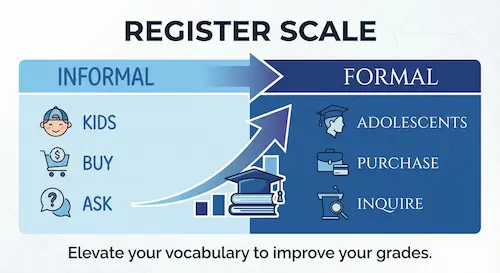
This is where many university students hit a wall. You might be able to chat with friends in English, but writing a formal essay is a different beast. Academic English is formal, objective, and precise.
The Gap Between Speaking and Writing
In speech, you can use gestures and tone to convey meaning. In writing, the words must do all the heavy lifting.
-
Spoken: "The company messed up big time."
-
Written: "The organization experienced a significant strategic failure."
For students who struggle to make this shift, english homework help services can provide model answers that demonstrate the appropriate academic register. Seeing your own informal thoughts translated into formal text is one of the fastest ways to learn.
Expanding Your Vocabulary
To write well, you need a robust vocabulary—especially for English language learners—supported by guidance that helps English language learners build confidence, expand word choice, and engage more actively in the writing process.
-
The Synonym Game: Never use the word "good" or "bad" in an essay. Use "beneficial," "advantageous," "detrimental," or "adverse."
-
Keep a Phrasebook: Don't just learn words; learn collocations (words that naturally go together). For example, you "conduct research," you don't "do research." You "make a decision," you don't "do a decision."
Part 4: Thinking in English (The Internal Switch)
Translating from your native language into English in your head often causes delays and awkward phrasing. The goal is to think directly in English, helping bridge the gap between ideas and expression while improving overall communication skills within a supportive learning environment.
How to Stop Translating
-
Label your environment: Look around the room and name objects in English.
-
Internal Monologue: When you are planning your week, do it in English. "I need to go to the library, then I will meet Sarah."
-
Monolingual Dictionary: Stop using a bilingual dictionary (e.g., Spanish-to-English). Use an English-to-English dictionary. This forces you to understand the definition in English, strengthening your cognitive associations.
This mental shift is crucial. When you stop translating word-for-word, your writing flow improves, and you become less reliant on tools like Google Translate, which often produce awkward academic phrasing. This approach responds to individual student needs through pedagogy, personalized guidance that helps you develop clearer, more confident academic writing.
Part 5: When You Need Professional Support
Even with dedication, the pressure of university deadlines can be overwhelming. Sometimes, the most effective way to learn is to see how a professional educator handles the task—engaging students in the classroom while helping them build and refine skills through clear, guided examples.
Learning from the Experts
There is no shame in seeking guidance. Professional assignment writers uk based can act as mentors. By reviewing a custom-written paper, you can see exactly how to structure a paragraph, how to integrate citations, and how to maintain a critical voice throughout an essay. This is active learning.
If you are struggling to make sense of a specific module, utilizing assignment help online uk services allows you to deconstruct a high-scoring paper. You can analyze how the writer transitioned between points and how they hedged their arguments (using words like "suggests" or "indicates" rather than "proves").
Why Choose My Perfect Writing for Your English Assignments?
Writing a speech or an essay is a specific craft. It requires a different tone than a casual conversation. If you are struggling to find the right "voice," or if your arguments feel weak, My Perfect Writing is here to help.
Free AI Detection Reports for English Assignments
In creative writing and analysis, authenticity is everything. Receive Turnitin®-verified originality reports ensuring your speeches, essays, and literature reviews are 100% plagiarism-free and aligned with your assignment rubric.
We prove that your voice is truly your own, helping you gain confidence, build language proficiency, and receive supportive guidance that considers diverse learning needs, including learning disabilities.
Expert-Written English Essays and Analysis
We don't just employ writers; we employ linguists. Get high-quality English literature assignment help and linguistic assignment help, crafted by qualified UK English academics. Our team has deep subject knowledge across poetry, prose, and critical theory, ensuring your work uses rhetorical devices correctly.
We focus on students’ real academic needs through interactive guidance, clear explanations, and constructive feedback that helps you build confidence, improve analysis skills, and strengthen your writing for future assignments.
Guaranteed Grade Improvement in English Writing
Whether it's textual analysis or discourse evaluation, our english assignment help uk ensures your submissions meet every rubric point. We offer unlimited edits until your work is academically sound, clearly understood, and persuasive enough to secure the grade you deserve—while empowering you with stronger comprehension, improved structure, and confidence in your academic writing.
Pay 25% Upfront for Essay Writing Help
We know students are on a budget. We have made professional help accessible with zero-risk pricing. Get affordable online English assignment help by paying only 25% to get started, and the rest after final approval. There are no hidden charges or surprises.
100% Confidential English Assignment Services
Your creative work is your intellectual property. All work is handled securely and remains private. Our assignment writing services UK never reuse or share your English papers—your academic integrity is always protected. We enhance your work while helping students build knowledge, support skill acquisition, and stay fully aligned with their academic targets through guided, ethical assistance.
24/7 English Assignment Help UK
Speeches are often last-minute tasks. Need urgent essay structuring, literature comparison, or linguistic theory analysis? Get real-time academic support whenever you need it. Our team is available 24/7 to deliver high-quality scripts in as little as 24 hours, supporting individual needs of students, academic targets supported, and urgent deadlines with reliable, focused assistance.
Conclusion
Achieving fluency in the English language is a dual process. It requires the courage to speak up and make mistakes, and the discipline to sit down and study the mechanics of writing. By combining immersion techniques like shadowing with rigorous reading and writing practice, you can break through the barrier of "Foreign Language Anxiety."
Remember, every expert was once a beginner. The goal is progress, not perfection. Whether you are giving a presentation or writing a dissertation, your unique perspective is valuable—don't let a language barrier silence you.
Find your voice. Own the language.
Frequently Asked Questions
How can I improve my English speaking quickly?
The fastest way to improve is total immersion. Change the language settings on your phone to English. Listen to English radio while you cook. Speak English with your classmates, even if you share a native language. The more your brain is forced to process the language, the faster it adapts. Consistency is more important than intensity; 15 minutes of practice every day is better than 3 hours once a week.
Is it okay to use translation apps for my assignment?
While translation apps have improved, they are dangerous for academic work. They often miss the nuance of specific terminology or use informal phrasing that is inappropriate for university essays. It is much safer to write in simple English that you understand than to rely on an app that might produce nonsense. If you are stuck, professional english homework help is a safer alternative to ensure accuracy.
How do I improve my academic vocabulary?
Read. Read journal articles, read broadsheet newspapers (like The Guardian), and read textbooks. When you see a word you don't know, write it down. Try to use it in a sentence the next day. Also, pay attention to the "academic word list" (AWL)— A list of the most common words used in academic texts—mastering these helps build a stronger writing foundation and instantly elevates your style, while supporting English language skill learners in developing confidence and academic clarity..
Can getting assignment help actually improve my English?
Yes, if you use it correctly. Don't just hand in the paper. Read it carefully. Compare it to your own writing. Look at how the professional writer constructed their sentences and how they linked paragraphs together. Use the custom paper as a study guide to identify your own weaknesses, strengthen your writing skills, and learn how to improve future assignments—especially helpful for students using English as a second language or developing clear, professional Business English.
What is the difference between conversational and academic English?
Conversational English is what you use with friends; it includes slang, contractions (can't, won't), and phrasal verbs (give up, look into). Academic English is formal, objective, and explicit. It avoids contractions (cannot, will not), uses Latin-based verbs (surrender, investigate), and relies on evidence rather than opinion. Understanding this register is key to achieving higher grades, supporting language acquisition through authentic language use and a collaborative approach that helps students apply these skills confidently in their academic work.
Meet Our Professional Essay Writers
Empowering Your Academic Writing Journey with Authority, Expertise, and Experience

Dr. Emma Wilson
PhD in Literature

Prof. James Chen
MSc in Computer Science

Dr. Sarah Ahmed
PhD in Law & Ethics
Ready to Work With Our Expert Writers?
