
Not sure where to start? Talk to our support team live.
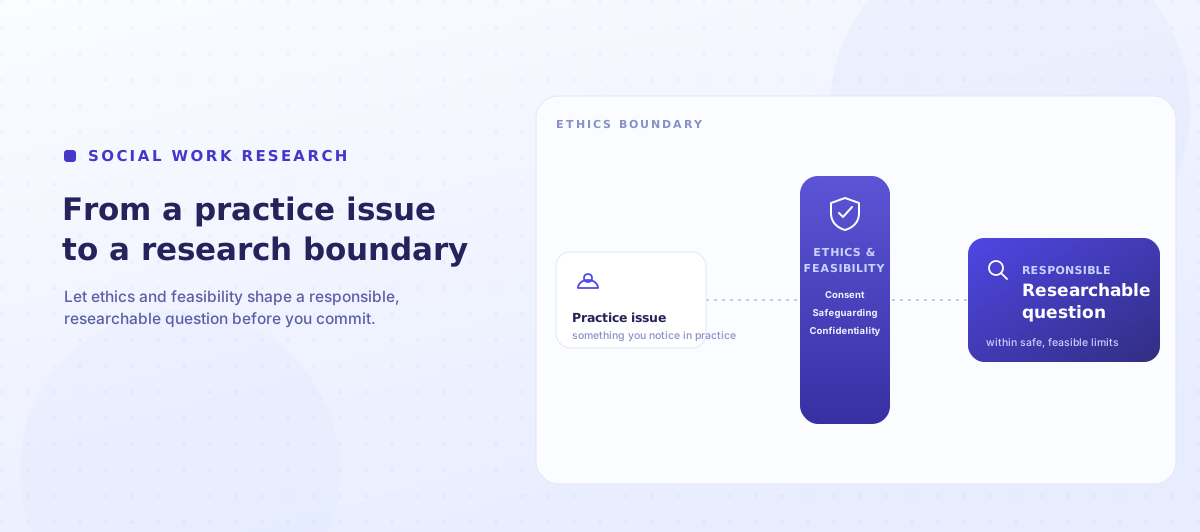
A practice issue passing through an ethics boundary — consent, safeguarding and confidentiality — to become a responsible, researchable question.

Social Work & Research Topics

Social Work Dissertation Ideas: A Practical, Ethical Guide

Choosing a social work dissertation topic means starting from practice, but a meaningful issue is not automatically a feasible or ethical dissertation. This guide gives ideas across safeguarding, children and families, mental health, adult care and more, and shows how ethics and feasibility should shape your research question.

  • Category: Social Work & Research Topics
  • 8 min read
  • Updated 2026-08-20

The short version

Quick answer

A strong social work dissertation topic starts from a real practice issue but is shaped by ethics and feasibility: it protects vulnerable people, is realistic for a student project, and can be answered with evidence you can gather responsibly. The safest student topics often study practitioners’ perspectives, policy or existing data rather than researching service users directly.

Start here

What makes a good social work dissertation topic?

Social work topics come from practice — a tension you notice on placement, a group whose needs feel overlooked, a policy that plays out messily on the ground. But a meaningful issue is not automatically a feasible or ethical dissertation, and that distinction matters more here than in almost any other subject. Our social work assignment support helps you plan and review your own academic work; it does not provide professional, clinical or practice advice, and it does not write your dissertation for you. A strong social work topic is:

  • Rooted in practice — a real issue for service users, practitioners or services.
  • Ethically responsible — it protects vulnerable people and respects consent, safeguarding and confidentiality.
  • Feasible for a student — realistic given your access, time and the limits of a student project.
  • Concept- or policy-anchored — connected to a framework, policy or professional debate.
  • Answerable — its scope and evidence base fit the word count.

Below you will find ideas by field, then how to let ethics and feasibility shape any of them into a defensible research question.

The essential skill

Let ethics and feasibility shape the research question

In social work, you narrow differently: you start from a practice issue, but ethics and feasibility decide what is actually researchable. A crucial early question is whose perspective you study. Directly researching vulnerable service users — children, people in crisis, people who have experienced abuse — is rarely appropriate or approvable for a student dissertation. Studying practitioners’ perspectives, policy, or existing data is usually safer and just as valuable. Work through it in stages:

From practice issue to a responsible question

Practice issueInformation-sharing in domestic abuse cases
Focus / conceptBalancing confidentiality and safeguarding duties
Whose perspectiveFrontline practitioners (not service users directly)
Feasible & ethical evidenceInterviews with practitioners, or policy/document analysis
Research question“How do frontline social workers describe balancing confidentiality and information-sharing in domestic abuse cases?”

Before committing, test the question against your programme’s ethics requirements: consent, safeguarding, confidentiality, participant vulnerability, and whether it is feasible within a student timeframe. The example above is a teaching illustration — your focus, design and analysis must be your own, and your university’s ethics process is the authority on what you may do. For turning findings into argument, see our guide on description vs analysis.

Check the brief first

Before choosing a topic, check what your dissertation brief actually requires

Brief Decoder breaks your dissertation handbook or assignment into clear requirements — task, scope, methods and marking criteria — so you can test an idea against what is actually expected before you invest in it.

Decode My Brief

Ideas by field (1 of 2)

Topic ideas: children, safeguarding, mental health and adult care

Use these as starting points. Most are framed around practitioners, policy or existing evidence — the safer, more feasible route for a student dissertation. Narrow the one that fits your brief using the process above.

Children & families

  • How practitioners describe building relationships with families during assessment.
  • Practitioner perspectives on early help and thresholds for intervention.
  • How a specific policy is understood and applied in children’s services.

Safeguarding

  • How practitioners navigate the tension between confidentiality and information-sharing.
  • Lessons practitioners take from published safeguarding reviews.
  • Multi-agency working: how professionals describe communication across services.

Mental health

  • Practitioner perspectives on the social model of mental health in practice.
  • How social workers describe their role alongside clinical colleagues.
  • Approaches to reducing stigma within a service, from a practitioner view.

Adult social care

  • How practitioners balance choice, risk and duty of care in adult safeguarding.
  • Experiences of implementing personalisation or strengths-based practice.
  • How care assessments are experienced by the professionals who carry them out.

Ground these in professional standards and evidence: Social Work England sets professional standards, the British Association of Social Workers publishes the code of ethics, and SCIE curates practice evidence.

Ideas by field (2 of 2)

Topic ideas: disability, ageing, domestic abuse, homelessness and more

Disability

  • How practitioners apply the social model of disability in assessment.
  • Transitions from children’s to adult services, from a practitioner view.

Ageing & older people

  • Practitioner perspectives on tackling social isolation among older adults.
  • How safeguarding of older people is understood across a service.

Domestic abuse

  • How practitioners describe risk assessment and safety planning.
  • Professional views on trauma-informed approaches in a service.

Homelessness & substance use

  • How practitioners work with people facing multiple disadvantage.
  • Professional perspectives on harm-reduction approaches in a service.

Youth & care leavers

  • How services describe supporting care leavers into adulthood.
  • Practitioner views on the corporate parenting role.

Practice, professional identity, policy & the digital

  • How newly qualified social workers describe developing professional identity.
  • Practitioner experiences of burnout, supervision and retention.
  • How a national policy reshapes day-to-day practice.
  • How digital records and remote working affect relationship-based practice.

For policy and evidence, GOV.UK and NICE guidance are strong anchors, and the Office for National Statistics provides context data. If you are weighing several ideas, our research topic-selection guide covers the same narrowing method.

Before you commit

A meaningful topic is not automatically a feasible dissertation

This is the single most important point in social work research. The topics that matter most — abuse, crisis, trauma, protection — are often the ones a student cannot ethically research directly. That does not mean avoiding important issues; it means approaching them responsibly. Before you commit, check honestly:

  • Who is your participant? If it is a vulnerable service user, reconsider. Studying practitioners, policy or existing data is usually safer and just as valuable.
  • Ethics approval. Will it realistically pass your university’s ethics process? If it clearly will not, change the design now, not later. Your programme’s ethics committee is the authority — not any tool or guide.
  • Safeguarding & confidentiality. Have you thought through consent, data protection, and what you would do if something concerning were disclosed?
  • Access & time. Can you actually recruit participants or reach the data within a student timeframe?
  • Scope. A defined focus keeps the question answerable — and, as our guide to why more sources is not the answer shows, depth beats breadth.

A responsible, feasible question you can research ethically will always beat an important one you cannot.

Test your idea

Found a topic? Check it fits the brief before you design your study

Use Brief Decoder to clarify the task, scope and marking expectations, then shape your own ethical, feasible research question around what the dissertation requires.

Try Brief Decoder

Why us

How My Perfect Writing supports social work students ethically

My Perfect Writing helps UK social work students understand their brief, plan their own research, review their own drafts and understand feedback. We support academic work only — we do not give professional, clinical or practice advice, and the research and writing remain entirely your own.

Understand your own brief

Brief Decoder helps you identify the task, scope, methods expectations and criteria before you choose or narrow a topic.

Review your own draft

Once you have written your own work, Marker’s Eye reviews structure, argument and use of evidence against marking expectations. It does not write or rewrite it.

Understand returned feedback

Feedback Decoder helps you turn supervisor or marker comments into clear, specific actions on your own work.

Plan ethically

We help you think through feasibility and research ethics for a student project — but your university’s ethics process is the authority, and every decision stays yours.

You stay the author

Your practice knowledge, design, analysis and final writing remain your own; support is focused on clarity, planning and review.

Start with the free resource

Use the free Topic, Ethics & Feasibility Planner to pressure-test an idea before you commit.

We support your academic work only — not professional or practice advice. You stay the author of your own research.

Questions

Frequently asked questions

What makes a good social work dissertation topic?
A good topic starts from a real practice issue but is shaped by ethics and feasibility. It protects vulnerable people, is realistic for a student project, and can be answered with evidence you can gather responsibly. Topics that study practitioners’ perspectives, policy or existing data are often stronger choices than those researching service users directly.
Can I research service users directly for my dissertation?
Usually not, especially with vulnerable groups such as children, people in crisis or people who have experienced abuse. Directly researching them is rarely appropriate or approvable for a student project. A safer, equally valuable approach is to study practitioners’ perspectives, analyse policy, or use existing data. Your university’s ethics process decides what is permitted.
How do ethics shape a social work topic?
Ethics decide what is actually researchable. Consent, safeguarding, confidentiality and participant vulnerability all shape your design, and your topic must pass your university’s ethics review. If an important issue cannot be researched safely as designed, change the approach — often by shifting to practitioners, policy or secondary data — rather than dropping the issue entirely.
What are good evidence sources for a social work dissertation?
Anchor your work in professional standards and evidence: Social Work England for standards, BASW for the code of ethics, and SCIE for practice evidence. GOV.UK and NICE provide policy and guidance, and the ONS offers context data. Existing data and policy analysis are often the most feasible and ethical evidence base for a student.
Does My Perfect Writing give social work practice advice?
No. My Perfect Writing supports your academic work only — understanding your brief, planning your own research, reviewing your own drafts and making sense of feedback. It does not provide professional, clinical or practice advice, and it does not write your dissertation. Your reading, ethics decisions, analysis and writing remain your own.
How narrow should a social work research question be?
Narrow enough to research ethically and feasibly within a student timeframe, but broad enough to connect to a professional debate or policy. A useful test: if you can name the practice issue, whose perspective you study, the method and how it stays ethical, it is probably focused enough. If any of those is unclear, keep refining.