

Step 1: The First Read (The Surface Meaning)
Before you start hunting for metaphors, you must understand what is actually happening.
- Read it aloud: Poetry is an oral tradition. You need to hear the rhythm.
- The Literal Translation: What is the plot? Who is speaking (the Persona)? Who are they speaking to?
- The Title: Never ignore the title. It is the poet's first clue. In Wilfred Owen's Dulce et Decorum Est, the irony begins with the title itself.
Tip: If you don't understand a word, look it up immediately. A single misunderstood word can change the entire tone of the poem.
Step 2: SMILE for Success (A Mnemonic for Analysis)
To ensure you cover every aspect required by UK exam boards (AQA, Edexcel, OCR), use the SMILE acronym.
S - Structure
How is the poem built?
- Stanzas: Are they regular or irregular? A chaotic structure might reflect a chaotic mind (e.g., in a war poem).
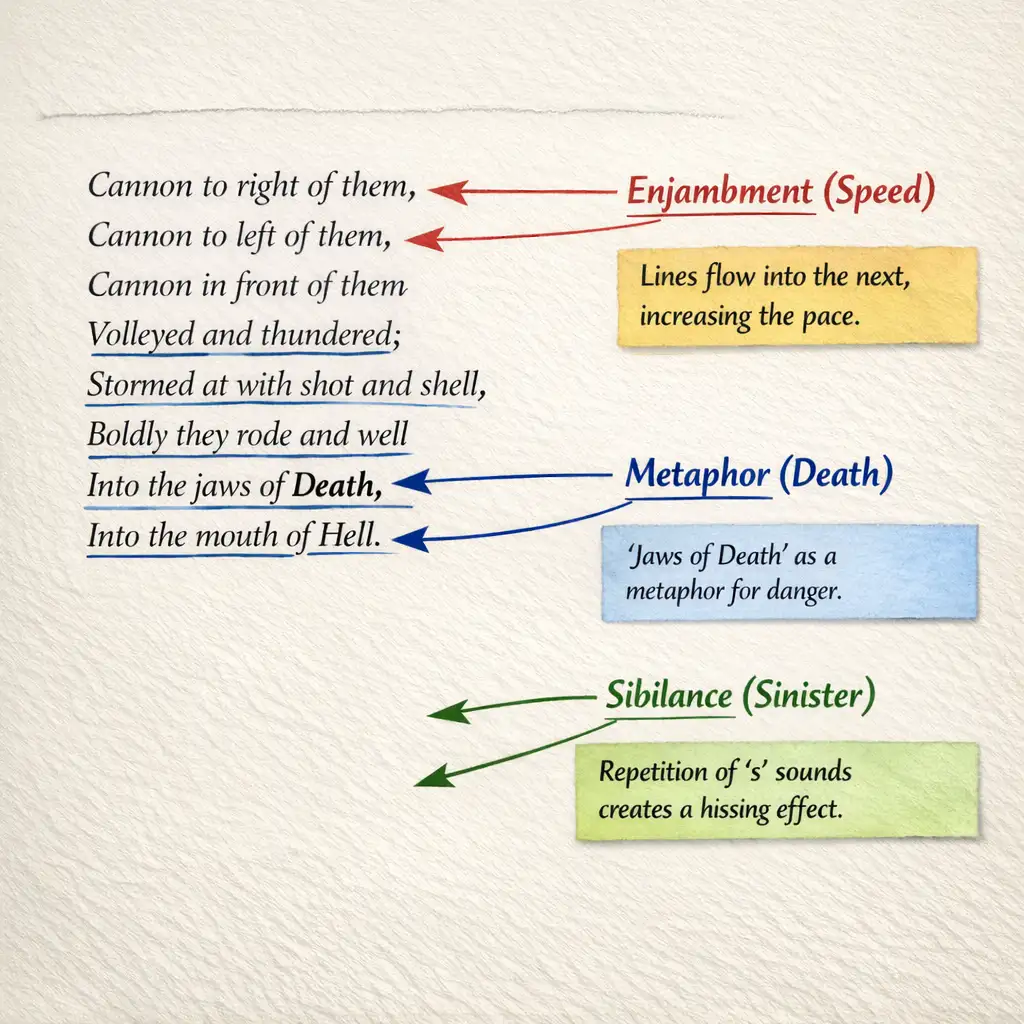
- Enjambment: Does a sentence run over the line break? This speeds up the pace.
- Caesura: Is there a full stop in the middle of a line? This creates a pause or a shock.
M - Meaning
What is the deeper message? Is it a love poem, or is it actually about obsession? (e.g., Porphyria's Lover).
I - Imagery
This is where you get the marks.
- Similes & Metaphors: Compare X to Y. Why? What effect does it create?
- Sensory Language: Sight, Sound, Smell.
- Symbolism: Does the "rose" represent love, or does the "thorn" represent pain?
L - Language
Look at the poet's word choice (Diction).
- Plosives: Sounds like P, B, D (harsh, explosive).
- Sibilance: Sounds like S, Sh (hissing, sinister, or soothing).
- Semantic Fields: A group of words related to one topic (e.g., "blood," "knife," "wound" = Semantic field of violence).
E - Effect
How does it make the reader feel? Shocked? Sad? Nostalgic? This is the "So What?" factor.
Step 3: Context is King (AO3)
In UK marking schemes (especially A-Level), Context (Assessment Objective 3) is vital. You cannot analyze a poem in a vacuum.
- Biographical Context: Was the poet suffering from depression? (e.g., Sylvia Plath).
- Historical Context: Was it written during WWI? (e.g., Siegfried Sassoon).
- Literary Context: Is it a Romantic poem? A Modernist poem?
Warning: Do not just "bolt-on" a history lesson. Link it to the text.
- Bad: "Wilfred Owen fought in WWI."
- Good: "Owen's use of graphic imagery reflects the brutal reality of trench warfare he experienced in WWI, challenging the patriotic propaganda of the time."
If you are struggling to find relevant context for your specific text, our english assignment help services can provide detailed background notes to enrich your analysis.
Step 4: Structuring Your Essay
You have the notes; now you need the essay. Avoid going line-by-line (it’s boring). Go theme-by-theme.
The Introduction
- State the poem’s title, author, and main theme.
- Outline your argument (Thesis Statement).
The Main Body (3-4 Paragraphs)
Use the PEEL method (Point, Evidence, Explanation, Link).
- Point: "The poet uses structure to convey the speaker's instability."
- Evidence: Quote the enjambment.
- Explanation: Analyze the effect. (e.g., "The lack of punctuation creates a breathless, panicked tone").
- Link: Connect back to the theme of mental health.
The Conclusion
- Summarize your main points.
- Give a final verdict on the poet's message.
The Poetry Foundation – A massive database of poems and biographies for research.
How My Perfect Writing Analyzes Poetry for You
Poetry analysis is subjective, but academic writing is objective. Bridging that gap is hard. Here is how My Perfect Writing's specialized services help you succeed.
Expert English Literature Assignment Help
We don't just employ writers; we employ literary critics. Our team consists of graduates from top UK universities who specialize in specific periods (Romanticism, Victorian, Post-Colonial). Whether you need help with a sonnet or free verse, we understand the technical vocabulary required for high grades.
Authentic Analysis, Zero AI
Poetry requires human emotion to understand. AI cannot feel the pathos in Keats or the anger in Angelou. We guarantee 100% human-written content. Our assignment help service provides Turnitin-verified reports, ensuring your analysis is original and insightful.
Pay 25% Upfront for Assignment Help
We know students are on a budget. We have revolutionized the industry.
Get premium support by paying just 25% upfront.
You review the draft analysis first. Only when you are satisfied with the depth and clarity do you pay the remaining balance.
"Help For Assignment UK" – 24/7 Support
Deadlines don't wait. If you have an urgent essay due tomorrow, our team is available round-the-clock. We offer work assignment help that fits your schedule, ensuring you never miss a submission.
Conclusion
Analyzing a poem is like solving a mystery. The poet has left you clues—in the rhythm, the line breaks, and the metaphors—and it is your job to piece them together to reveal the hidden meaning. By using a structured approach like SMILE and remembering to link everything back to Context, you can turn a confusing text into a compelling essay.
However, if you are staring at a page of complex verse and feeling lost, you don't have to struggle alone.
My Perfect Writing offers the expert mentorship and analytical support you need to decode the toughest texts. With our qualified writers and risk-free payment options, you can submit your literature assignments with confidence.
Uncover the meaning. Secure the grade.
Get Expert English Literature Help Now
Frequently Asked Questions
Do I need to mention the rhyme scheme in every analysis?
No, simply identifying the rhyme scheme (like ABAB) won't earn you marks unless you explain why it matters. You should only discuss rhyme if it contributes to the poem's meaning. For example, a strict rhyme scheme might suggest order, control, or entrapment, while a broken rhyme scheme could reflect chaos or a disturbed state of mind. Always link the technique to the effect.
How many quotes should I use in my essay?
In poetry analysis, quality is far more important than quantity. You do not need to quote large chunks of the poem. Instead, focus on embedding short, impactful quotes into your sentences. A well-chosen phrase or even a single word that you analyze in depth is much more effective than copying out four lines of a stanza without explanation.
Is it possible to interpret a poem "wrongly"?
In English Literature, there is rarely a single "correct" answer. As long as you can support your interpretation with evidence from the text, your view is valid. If you think a poem is about death, prove it with imagery. If you think it is about rebirth, prove it with tone. Examiners reward original, well-argued interpretations over generic ones.
Can My Perfect Writing help with "Unseen Poetry" exams?
Yes, absolutely. The "Unseen Poetry" component is often the most daunting part of the exam. We can provide you with practice papers and custom-written model answers that demonstrate exactly how to approach a text you have never seen before. By learning our structured method, you can train yourself to spot techniques quickly under time pressure.
What is the difference between Tone and Mood?
This is a common confusion. Tone refers to the poet's or speaker's attitude toward the subject matter (for example, angry, sarcastic, or reverent). Mood, on the other hand, refers to the atmosphere or feeling created for the reader (such as gloomy, tense, or hopeful). Distinguishing between the author's voice and the reader's experience is a sign of sophisticated analysis.
Meet Our Professional Essay Writers
Empowering Your Academic Writing Journey with Authority, Expertise, and Experience

Dr. Emma Wilson
PhD in Literature

Prof. James Chen
MSc in Computer Science

Dr. Sarah Ahmed
PhD in Law & Ethics
Ready to Work With Our Expert Writers?
