

Why is Reflection Crucial in Nursing?
Before we dissect the model, we must understand the why. Reflection is often dismissed as "navel-gazing," but it is actually a rigorous clinical safety tool.
1. Emotional Processing
Nursing is traumatic. You deal with pain, death, and ethical dilemmas daily. Reflection provides a safe space to process difficult feelings (like guilt after a mistake or anger at a system failure) so they don't lead to burnout.
2. Developing Clinical Judgement
By analyzing why you made a specific decision (e.g., "Why did I delay giving that medication?"), you improve your critical thinking. You move from a novice who follows rules to an expert who understands the nuance of care.
3. NMC Revalidation
Every three years, every registered nurse in the UK must submit five written reflective accounts to renew their registration. Learning how to write a good reflection now isn't just for your degree; it is a skill you will use for your entire career to prove you are fit to practice.
The 6 Stages of Gibbs' Reflective Cycle: A Deep Dive
Gibbs' model is cyclical, meaning the end of one reflection leads to the beginning of new learning. Here is exactly how to tackle each stage in your nursing assignment.
1. Description (What happened?)
This is the starting point. Keep it factual, concise, and anonymous.
- The Goal: Paint the picture for the reader without "waffling."
- What to Include:
- Context: Where were you? (e.g., "On a busy surgical ward...").
- The Event: What actually happened? (e.g., "I was attempting to catheterize a patient...").
The 6 Stages of Gibbs' Reflective Cycle: A Deep Dive
Gibbs' model is cyclical, meaning the end of one reflection leads to the beginning of new learning. Here is exactly how to tackle each stage in your nursing assignment.
1. Description (What happened?)
This is the starting point. Keep it factual, concise, and anonymous.
- The Goal: Paint the picture for the reader without "waffling."
- What to Include:
- Context: Where were you? (e.g., "On a busy surgical ward...").
- The Event: What actually happened? (e.g., "I was attempting to catheterize a patient...").
- The Outcome: What was the immediate result? (e.g., "The procedure was unsuccessful...").
- Crucial Rule: Do not analyze yet! Just state the facts. Do not say "I failed because..." yet. Save that for later.
2. Feelings (What were you thinking and feeling?)
This stage is unique to Gibbs. Unlike standard academic essays, where emotion is removed, here it is central.
- The Goal: Be honest about your internal state.
- Key Questions: Were you anxious? Confident? Frustrated with a colleague? What did you think the patient was feeling?
- Example: "Initially, I felt confident as I had practiced this skill in simulation. However, as the procedure became difficult, I felt a rising sense of panic and embarrassment in front of my mentor."
- Why it matters: Acknowledging panic explains why your hands might have shaken, impacting the procedure. It links emotion to clinical performance.
3. Evaluation (What was good and bad?)
Now, you start to judge the situation objectively.
- The Goal: Balance the perspective.
- The Good: "Despite my anxiety, I maintained a sterile field throughout the attempt." (This shows you prioritized safety).
- The Bad: "I did not communicate with the patient effectively while I was struggling, which likely increased their distress."
- Focus: Look at your own actions, the team's actions, and the outcome for the patient.
4. Analysis (The Academic Core)
This is the most important section. It usually carries 40-50% of the marks. This is where you bring in the literature and evidence. You need to explain why things happened.
- The Goal: Link practice to theory.
- How to do it:
- Link to Physiology: "The difficulty in catheterization may have been due to prostatic enlargement, a common complication in elderly males (Smith, 2020)."
- Link to Psychology: "My panic can be explained by the 'Fight or Flight' response, which reduces fine motor skills (Jones, 2019)."
- Link to Ethics: "By stopping the procedure, I adhered to the ethical principle of Non-Maleficence (Beauchamp & Childress, 2013)."
- Support: If you struggle to find relevant sources, our nursing essay writing service uk experts can help you locate current research to back up your analysis.
- The Outcome: What was the immediate result? (e.g., "The procedure was unsuccessful...").
- Crucial Rule: Do not analyze yet! Just state the facts. Do not say "I failed because..." yet. Save that for later.
2. Feelings (What were you thinking and feeling?)
This stage is unique to Gibbs. Unlike standard academic essays, where emotion is removed, here it is central.
- The Goal: Be honest about your internal state.
- Key Questions: Were you anxious? Confident? Frustrated with a colleague? What did you think the patient was feeling?
- Example: "Initially,,,,,,,,,,,,,,,,,,,,,,,,,,,,,,,,,,,,,,,,,,,,,,,,,,,,,,,,,,,,,,,,,,,,,,,,,,,,,,,,,,,,,,,,,,,,,, I felt confident as I had practiced this skill in simulation. However, as the procedure became difficult, I felt a rising sense of panic and embarrassment in front of my mentor."
- Why it matters: Acknowledging panic explains why your hands might have shaken, impacting the procedure. It links emotion to clinical performance.
3. Evaluation (What was good and bad?)
Now, you start to judge the situation objectively.
- The Goal: Balance the perspective.
- The Good: "Despite my anxiety, I maintained a sterile field throughout the attempt." (This shows you prioritized safety).
- The Bad: "I did not communicate with the patient effectively while I was struggling, which likely increased their distress."
- Focus: Look at your own actions, the team's actions, and the outcome for the patient.
4. Analysis (The Academic Core)
This is the most important section. It usually carries 40-50% of the marks. This is where you bring in the literature and evidence. You need to explain why things happened.
- The Goal: Link practice to theory.
- How to do it:
- Link to Physiology: "The difficulty in catheterization may have been due to prostatic enlargement, a common complication in elderly males (Smith, 2020)."
- Link to Psychology: "My panic can be explained by the 'Fight or Flight' response, which reduces fine motor skills (Jones, 2019)."
- Link to Ethics: "By stopping the procedure, I adhered to the ethical principle of Non-Maleficence (Beauchamp & Childress, 2013)."
- Support: If you struggle to find relevant sources, our nursing essay writing service uk experts can help you locate current research to back up your analysis.
5. Conclusion (What else could you have done?)
Summarize what you have learned. Be specific.
- The Goal: Identify the gap in your knowledge or skill.
- Key Questions: Could I have prepared the patient better? Should I have asked for help sooner?
- Example: "I realized that while my technical knowledge was sound, my situational awareness was poor. I focused too much on the task and not enough on the patient."
6. Action Plan (If it arose again, what would you do?)
This closes the loop. How will you change your future practice?
- The Goal: Professional development.
- Action: "I will arrange a supervised practice session with the Practice Educator. I will also read the Trust's policy on difficult catheterization."
- SMART Goals: Make your plan Specific, Measurable, Achievable, Relevant, and Time-bound.
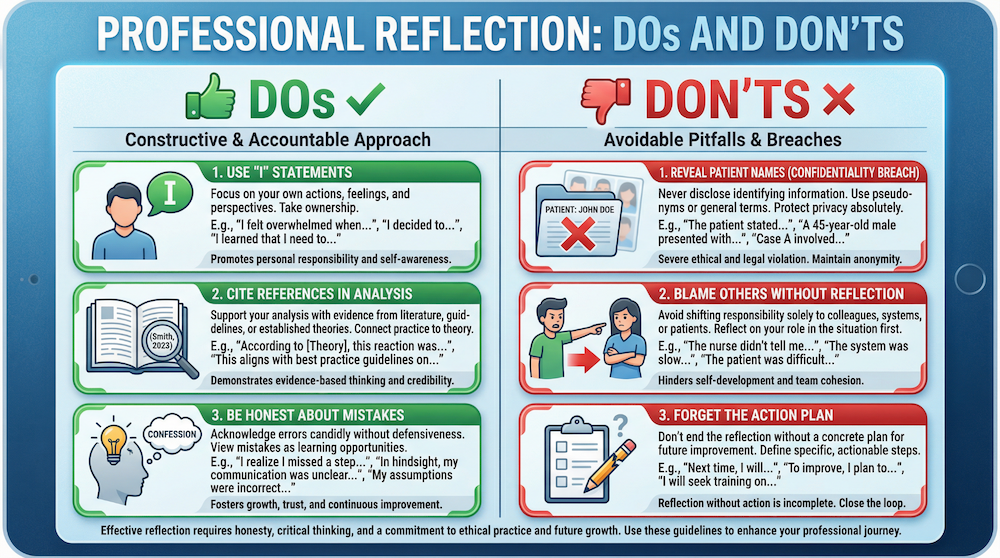
A chart showing key DOs and DON’Ts for professional reflection, including using “I” statements, citing evidence, admitting mistakes, and avoiding patient details, blame, or missing action plans.
Why Students Struggle with Gibbs
Even though the model is simple, writing it effectively is hard.
- Over-Description: Students spend 1,000 words describing the event ("Then I did this, then he said that...") and only 200 words analyzing it. This leads to a low grade.
- Lack of References: A reflection is still an academic essay. You cannot just write your opinion; you must back it up with evidence (NICE guidelines, research journals).
- Being Too Hard on Yourself: Reflection isn't about beating yourself up. It is about constructive criticism. A good reflection admits a mistake but focuses on the learning.
If you find yourself stuck in the "Description" phase, seeking help with nursing assignment structuring can help you rebalance your essay to focus on the high-scoring Analysis section.
How My Perfect Writing Supports Reflective Practice
We know that nursing students are often exhausted. Writing a deep psychological analysis of your shift after working 12 hours is a massive ask. We are here to help you articulate your experience.
Pay 25% Upfront for Nursing Essay Help
We have revolutionized the industry to be student-friendly.
Get expert nursing assignment assistance with transparent pricing — pay just 25% upfront.
- Step 1: Deposit 25% to secure a clinical writer.
- Step 2: We draft the reflection based on your brief notes (e.g., "I made a drug error").
- Step 3: You review the clinical accuracy and the integration of theory.
- Step 4: Pay the remaining balance only when you are satisfied.
Clinical Writers, Not Just Academics
Our team includes writers with nursing backgrounds. They understand the reality of the ward. They know what "compassion fatigue" feels like. This ensures your nursing essay help feels authentic and demonstrates genuine insight, not just textbook theory.
Confidentiality is Key
Reflection requires vulnerability. You might admit to a mistake or a near-miss. We guarantee 100% confidentiality. Your personal reflections and your identity are never shared. We also ensure all patient details are anonymized (using pseudonyms like "Mr. X") to comply strictly with GDPR and NMC standards.
Support for All Reflective Models
While Gibbs is the most common, we also cover Driscoll (What? So What? Now What?), Johns, and Rolfe. Whatever your university requires, we can adapt your experience to the framework.
Conclusion
Gibbs' Reflective Cycle is more than just a homework requirement; it is a tool for professional survival. It allows you to make sense of the chaotic, emotional, and complex world of nursing. By systematically moving through the stages—from feelings to analysis to action—you transform every shift into a learning opportunity.
However, bridging the gap between raw emotion and academic theory is difficult. If you are struggling to find the right literature to support your feelings, or if you are worried your reflection is too descriptive, you don't have to do it alone.
My Perfect Writing offers the clinical expertise and academic rigor you need. With our Pay 25% Upfront model, you can get expert support to turn your clinical experiences into distinction-grade essays.
Reflect deeply. Practice safely.
Get Expert Gibbs Reflection Help Now
Frequently Asked Questions
Can I use the first person in a reflective essay?
Yes, using the first person is essential in reflective writing. Since reflection is a personal account of your experiences, phrases like "I felt" or "I decided" are necessary to convey your unique perspective. However, when you reach the Analysis section, you should blend this personal voice with academic language to link your experience to wider nursing theories.
How many references do I need for a reflection?
Although a reflective essay is personal, it is still an academic assignment that requires an evidence base. You should aim for a similar number of references as a standard essay, typically around 10 to 15 sources for a 2,000-word piece. These references are most critical in the Analysis and Conclusion stages to validate your clinical reasoning and demonstrate that your actions align with best practice.
What if I didn't have a negative experience to reflect on?
Gibbs' model works just as well for positive experiences. You can reflect on a time when everything went right to understand why it was successful. Analyzing a successful interaction or procedure helps you identify the specific skills and behaviors that contributed to the positive outcome, allowing you to replicate that success in future practice.
Can My Perfect Writing write my reflection from scratch?
Yes, we can. If you provide us with a brief list of what happened during a specific clinical event—such as a medication error, a patient fall, or a challenging communication scenario—we can build a full Gibbs cycle around it. Our writers will find the relevant theory, structure the emotional journey, and create a robust Action Plan to demonstrate your learning.
How should I allocate my word count across the sections?
While there are no strict rules, a balanced reflection typically spends about 10% of the word count on the Description and another 10% on Feelings. The Evaluation and Conclusion should each take up about 15%, and the Action Plan around 10%. The most significant portion, usually 40%, should be dedicated to the Analysis, as this is where you demonstrate your critical thinking and earn the most marks.
Meet Our Professional Essay Writers
Empowering Your Academic Writing Journey with Authority, Expertise, and Experience

Dr. Emma Wilson
PhD in Literature

Prof. James Chen
MSc in Computer Science

Dr. Sarah Ahmed
PhD in Law & Ethics
Ready to Work With Our Expert Writers?
